viernes, 6 de septiembre de 2013

¿Se deben evitar los nitratos y nitritos en los alimentos?

AVOID NITRATES AND 

NITRITES IN FOOD

April 1, 2013
Nitrates and nitrites are chemical compounds that cause a lot of consumer confusion.
Nitrates are a normal part of the diet, but excessive levels can cause problems, especially for kids who pound for pound take in more than adults do. They have been linked to diseases like leukemia, non-Hodgkin lymphoma, and ovarian, colon, rectal, bladder, stomach, esophageal, pancreatic, and thyroid cancer.
They’re found in our diets in several ways: as synthetic food preservatives and naturally occurring in fruits and vegetables like spinach and celery. Sodium nitrate and potassium nitrite are added to cured meat to preserve its color, prevent fats from going rancid, and stop bacteria from growing. They’re also found in drinking water thanks to nitrogen-based fertilizers as well as livestock waste.
Here’s where things get tricky: If nitrites are exposed to high heat during cooking, they can convert to nitrosamines, which are carcinogenic. And when nitrates are used as a food additive or consumed, they can convert into nitrites.
Scientists believe that these conversions may be responsible for the link they’ve discovered between nitrates and nitrites and the diseases listed above. Nitrate or nitrite exposure has also been known to cause pregnancy complications and infant health problems.
Before you give up celery for good, keep in mind that there’s a difference between eating nitrates added to foods as preservatives and consuming them via produce. Nitrates that occur naturally are found alongside compounds like vitamin C that inhibit their conversion into nitrosamines in the body. When we eat nitrates and nitrites in foods artificially treated with them, we may not be getting these complementary nutrients and their preventative effects.
Here’s how to keep nitrates and nitrites off your plate:
1. Minimize consumption of processed foods and cured meat products like hot dogs, sausage, and cold cuts. Check labels carefully though—these compounds are also found in other products that contain processed meat and even some meat-free products.
2. Don’t be fooled by “uncured” or nitrate-free brands. These products typically contain high amounts of nitrates obtained from ingredients like celery juice, which means they could contain as much as if not more than their traditional counterparts.
3. Eat organic foods. They’re not grown with synthetic nitrogen fertilizers, which can boost a crop’s nitrate content significantly.
4. If you live in an agricultural region, consider treating your water with a home water distiller, a reverse osmosis filter, or an ion exchange filter to remove any fertilizer nitrates that have accumulated in the groundwater.
5. Eat a diet high in antioxidants. Certain vitamins, like vitamin C, can reduce the conversion of nitrates.

Organizador gráfico sobre nitratos y nitritos en los alimentos

KNOW
WANT TO KNOW
LEARNED
- El consumo de nitratos y nitritos en la dieta debe ser el menor posible ya que son cancerígenos.
- Estos compuestos se encuentran en los conservantes y colorantes utilizados en la elaboración de fiambres, panchos, chorizos, etc.
- ¿Qué cantidad de nitratos y nitritos es recomendable consumir para que no tengan efectos adversos en la salud?
 - ¿Qué otros efectos puede tener para el organismo?
- ¿En qué otros alimentos, además de carnes procesadas, se encuentran estos compuestos?
- ¿Existen alimentos que “neutralicen” su efecto?
-  Si son cancerígenos, ¿por qué se permite su uso en este tipo de alimentos que muchas personas consumen a diario?
- Los nitratos son una parte normal de la dieta, peo niveles excesivos pueden causar problemas.
- Su consumo se ha relacionado con enfermedades como leucemia, linfoma no- Hodking, de ovario, colon, recto, vejiga, estómago esófago, páncreas y cáncer de tiroides. También se sabe que causan complicaciones en el embarazo y problemas de salud infantil.
- Además de hallarse como conservante se encuentran en algunas frutas y verduras, y en el agua potable como consecuencia de los fertilizantes a base de nitrógeno y los residuos ganaderos.
- Su consumo en frutas y verduras no es riesgoso pues se encuentran junto a la vitamina C que inhiben su conversión en nitrosminas en el cuerpo.
Para minimizar los efectos negativo de estos compuestos se aconseja: minimizar el consumo de alimentos procesados y productos cárnicos curados, consumir alimentos orgánicos, considerar el tratamiento de agua con un destilador en el hogar, y tener una dieta rica en antioxidantes.

Alimentos que contienen nitratos y nitritos


viernes, 30 de agosto de 2013

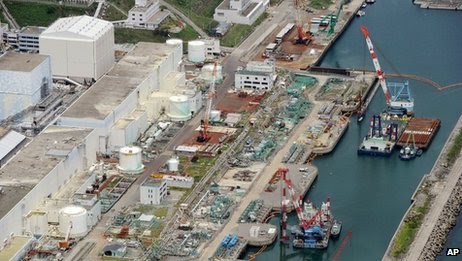
Planta nuclear de Fukushima: pérdida de agua radiactiva


20 August 2013 Last updated at 10:57 GMT

Fukushima nuclear plant: Radioactive water leak found


The tsunami knocked out cooling systems to the reactors at Fukushima

Radioactive water has leaked from a storage tank into the ground at Japan's Fukushima plant, its operator says.
Tokyo Electric Power Company (Tepco) said the leak of at least 300 tonnes of the highly radioactive water was discovered on Monday.
The plant, crippled by the earthquake and tsunami in 2011, has seen a series of water leaks and power failures.
The tsunami knocked out cooling systems to the reactors, three of which melted down.
An employee discovered the leak on Monday morning, Tepco said in a statement.


Officials described the leak as a level-one incident - the lowest level - on the International Nuclear and Radiological Event Scale (Ines), which measures nuclear events.
This is the first time that Japan has declared such an event since the 2011 earthquake and tsunami, however.
Under the Ines, events have seven categories starting with Level 0 ("without safety significance") and Levels 1-3 denoting "incidents" while Levels 4-7 denote "accidents".
A puddle of the contaminated water was emitting 100 millisieverts an hour of radiation, Kyodo news agency said.
Masayuki Ono, general manager of Tepco, told Reuters news agency: "One hundred millisieverts per hour is equivalent to the limit for accumulated exposure over five years for nuclear workers; so it can be said that we found a radiation level strong enough to give someone a five-year dose of radiation within one hour."

More monitoring
A Tepco official told a press conference on Tuesday that the water probably leaked from a tank after escaping a concrete barrier.
Workers were pumping out the puddle and the remaining water in the tank and would be transferring it to other containers, Kyodo added.
Water is being pumped into the reactors after cooling systems were knocked out by the tsunami.
Hundreds of tanks were built to store the contaminated water. Some of them had experienced similar leaks since 2012, but not on this scale, a Tepco official said.
Tepco had been instructed to retrieve contaminated soil and to strengthen monitoring of the surrounding environment, a regulatory official told Agence-France Presse news agency.
No major changes in radiation levels outside the plant had been observed so far, the official added.
The incident comes days after Tepco admitted that as much as 300 tonnes of contaminated water a day was leaking from the damaged reactor buildings to the sea.


Organizador gráfico sobre agua radiactiva en Fukushima


KNOW
WANT TO KNOW
LEARNED
- En 2011 un terremoto, y posterior tsunami, provocó la ruptura de los reactores causando la segunda pero catástrofe radiactiva después de Chernobyl.
- Se encontró agua radiactiva afuera de la planta de Fukushima. Se está investigando el origen.

- ¿Qué tiene el agua radiactiva?
- ¿Cuál es la situación actual de la planta?
- ¿Qué perjuicios puede tener para las personas que estuvieron en contacto con el agua radiactiva?
- Fueron descubiertas pérdidas de 300 toneladas de agua radiactiva.
- La pérdida fue catalogada como “incidente”. El nivel más bajo en la escala de eventos nucleares y radiactivos.
- Un charco de agua contaminada emitió 100 milisieverts de radiación en una hora.
100 milisieverts por hora equivale al límite de exposición acumulada por 5 años de un trabajador nuclear.
- Un funcionario de Tepco dijo en una conferencia que el agua provenía probablemente del escape de una barrera de hormigón.
- Cientos de tanques fueron construidos para contener el agua contaminada. Algunos han tenido pérdidas desde 2012 pero no a esta escala.
- El incidente ocurrió días después que Tepco admitió que 300 toneladas de agua contaminada al día son vertidos al océano desde los reactores dañados.
- Tepco dice que esta es la pero fuga en volumen y en términos radiactivos. Supera 80 millones de veces el límite permitido de bequereles por litro en agua potable.
- La preocupación es que esta agua sea vertida dentro del mar que está a 100 metros de distancia.

Agua radiactiva en la costa de Fukushima

jueves, 29 de agosto de 2013

Texto 1 Conectivismo


                                        http://www.connectivism.ca/about.html
Connectivism is a learning theory for the digital age. Learning has changed over the last several decades. The theories of behaviourism, cognitivism, and constructivism provide an effect view of learning in many environments. They fall short, however, when learning moves into informal, networked, technology-enabled arena. Some principles of connectivism:

§  The integration of cognition and emotions in meaning-making is important. Thinking and emotions influence each other. A theory of learning that only considers one dimension excludes a large part of how learning happens.

§  Learning has an end goal - namely the increased ability to "do something". This increased competence might be in a practical sense (i.e. developing the ability to use a new software tool or learning how to skate) or in the ability to function more effectively in a knowledge era (self-awareness, personal information management, etc.). The "whole of learning" is not only gaining skill and understanding - actuation is a needed element. Principles of motivation and rapid decision making often determine whether or not a learner will actuate known principles.

§  Learning is a process of connecting specialized nodes or information sources. A learner can exponentially improve their own learning by plugging into an existing network.

§  Learning may reside in non-human appliances. Learning (in the sense that something is known, but not necessarily actuated) can rest in a community, a network, or a database.

§  The capacity to know more is more critical that what is currently known. Knowing where to find information is more important than knowing information.

§  Nurturing and maintaining connections is needed to facilitate learning. Connection making provides far greater returns on effort than simply seeking to understand a single concept.

Learning and knowledge rest in diversity of opinions.

Learning happens in many different ways. Courses, email, communities, conversations, web search, email lists, reading blogs, etc. Courses are not the primary conduit for learning.

Different approaches and personal skills are needed to learn effectively in today's society. For example, the ability to see connections between fields, ideas, and concepts is a core skill.

Organizational and personal learning are integrated tasks. Personal knowledge is comprised of a network, which feeds into organizations and institutions, which in turn feed back into the network and continue to provide learning for the individual. Connectivism attempts to provide an understanding of how both learners and organizations learn.

Currency (accurate, up-to-date knowledge) is the intent of all connectivist learning.

Decision-making is itself a learning process. Choosing what to learn and the meaning of incoming information is seen through the lens of shifting reality. While there is a right answer now, it may be wrong tomorrow due to alterations in the information climate impacting the decision.

Learning is a knowledge creation process...not only knowledge consumption. Learning tools and design methodologies should seek to capitalize on this trait of learning.